But for casual fans, new fans or people checking quickly during the day, a full scorecard can sometimes feel dense.
This is where AI is beginning to change cricket coverage. Instead of forcing every fan to interpret a scorecard alone, AI can help turn match data into short summaries, plain-language explanations, player insights and personalized updates.
A fan might ask what changed in the last five overs, why a target was revised, who had the biggest impact or whether a chase is still realistic.
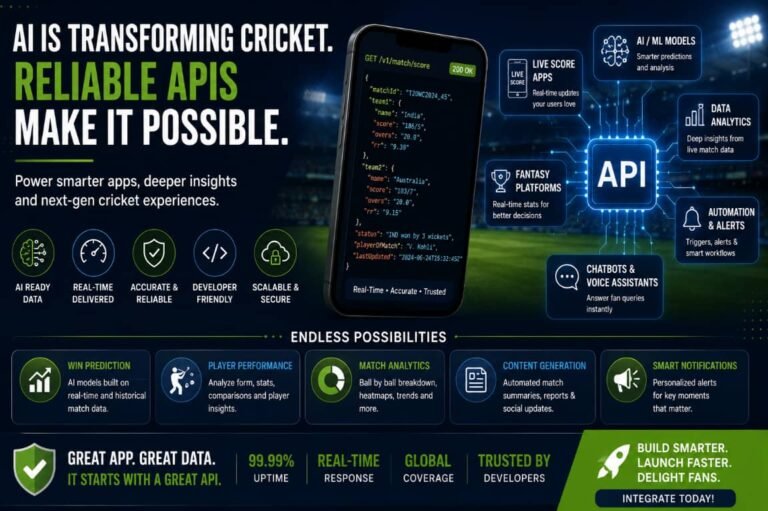
But AI does not work well without accurate data. Smart summaries need live scores, scorecards, overs, wickets, player names, innings state, match status and result context.
How AI Uses Cricket Data?
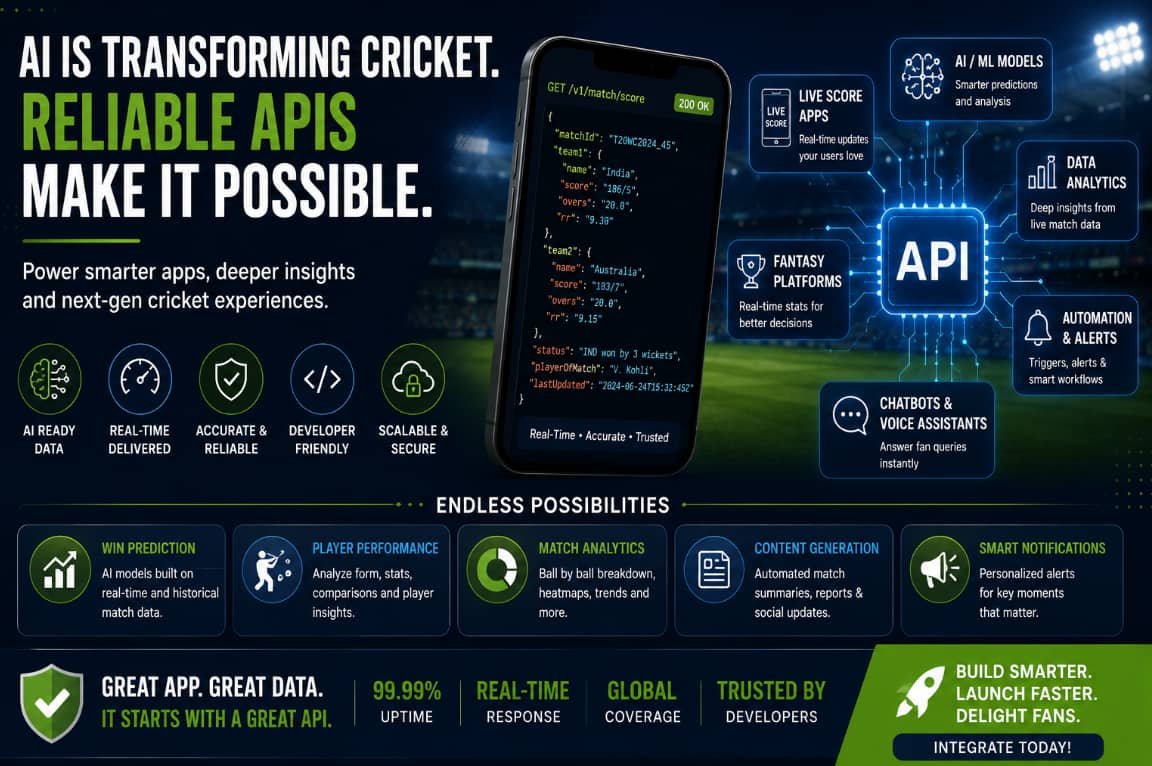
A platform using a reliable Cricket API can give AI the structured information it needs to produce useful cricket explanations instead of vague or misleading text.
The Scorecard Is Still the Foundation
AI may feel new, but it is building on something cricket has used for generations: the scorecard.
A cricket scorecard is one of the most efficient information formats in sport. It records batting, bowling, dismissals, overs, extras, fall of wickets and match totals in a structured way.
For an experienced fan, the scorecard is almost a story in numbers. It can reveal a cautious start, a middle-order recovery, a late collapse or a bowling spell that changed the match. AI can help explain that story, but it still needs the scorecard first.
“Cricket is an art, like the theatre, ballet, opera or the dance.”
— C. L. R. James
That quote captures why cricket data needs interpretation. The numbers matter, but the meaning behind them matters too. AI can help bridge that gap by turning structured scorecard information into readable summaries for different types of fans.
What Makes a Cricket Summary “Smart”?
A basic match summary might say who won and by how many runs or wickets. A smart summary should do more.
It should explain how the match developed, which moments mattered and which players shaped the result.
For example, instead of saying “Team A won by 24 runs,” a better summary might explain that Team A recovered from early wickets, built a decisive middle-order partnership and then defended the total through disciplined death bowling.
That kind of summary is more useful because it explains the match, not just the outcome.
To create that explanation, AI needs structured data such as:
- Final score and result margin
- Innings scorecards
- Batting and bowling figures
- Fall of wickets
- Partnerships
- Overs and run rates
- Match format
- Venue and tournament context
- Match status and result type
The AI layer can write the explanation, but the data layer provides the facts.
AI Can Explain Momentum, Not Just Results
Cricket is a game of momentum. A team may look comfortable until two wickets fall in one over.
A chase may look difficult until one batter targets a weak bowling matchup. A Test innings may shift after a long partnership, even if the scoreboard changes slowly.
AI can help fans understand those changes. It can look at recent overs, wickets, scoring rate and partnership data to explain whether pressure is rising or falling. This is especially useful for fans who cannot watch every ball.
Imagine a fan opening an app after missing 45 minutes of play. The score alone may show 138/5.
A smart summary could explain that the batting side lost three wickets for 18 runs after a strong start, and that the bowling side has taken control through spin in the middle overs. That is far more helpful than a number alone.
Ball-by-Ball Data Makes AI More Specific
Ball-by-ball data is one of the most valuable inputs for AI cricket summaries. It allows the system to see the rhythm of an over: dot balls, singles, boundaries, wickets, wides, no-balls and pressure moments.
Without ball-by-ball data, AI may only summarize the broad score. With ball-by-ball data, it can explain how a bowler built pressure, how a batter changed momentum or why the final over became decisive.
For example, a sequence of dot, dot, wicket, single, dot, dot tells a very different story from four, six, single, four, two, one.
Both overs are just six balls, but the emotional experience for fans is completely different. AI can turn those patterns into readable match context when the data is clean and structured.
Smart Summaries Need Match Status
One of the biggest risks with AI-generated cricket summaries is missing match status.
Cricket has many states that affect how a match should be explained: live, delayed, innings break, rain interruption, revised target, abandoned, completed or no result.
If AI does not know the match status, it may produce the wrong kind of summary. It might write a final recap while the match is still delayed.
It might ignore that a target was revised. It might describe an abandoned match as if it was completed normally.
This is why platforms should not feed AI only the score. They should provide match status, innings state and official result type.
Reviewing structured resources such as Cricket API documentation helps teams understand which fields matter before building automated summaries or AI-powered fan features.
AI Can Make Cricket Easier for Casual Fans
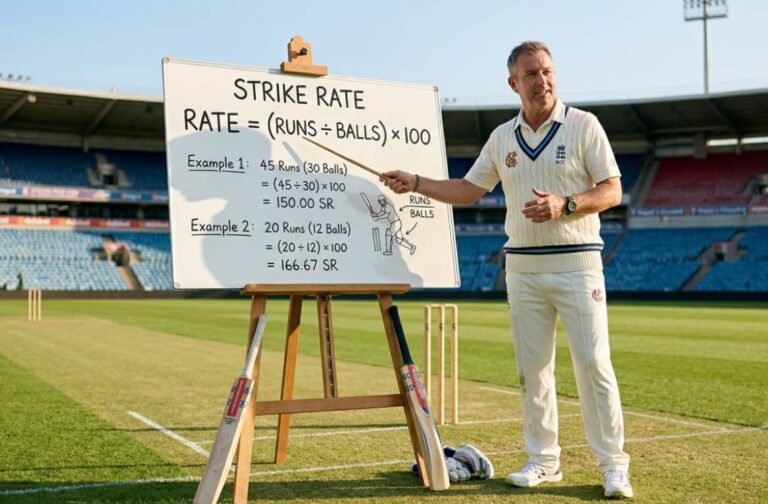
Cricket can be intimidating for new fans. Terms such as required run rate, DLS, economy rate, strike rate, powerplay, follow-on and net run rate may not be obvious. AI can make cricket more accessible by explaining these ideas in context.
A casual fan might see that a team needs 48 runs from 30 balls with six wickets in hand. An experienced fan may immediately understand that the batting side is in a reasonable position.
A newer fan may not. AI can explain the situation in plain language: the chase is still manageable, but that a wicket or two quiet overs could change the situation.
This does not replace detailed scorecards for serious fans. It adds another layer for people who want quick understanding.
The best cricket platforms can serve both audiences: detailed data for experts and simple explanations for newer fans.
Player Insights Become More Useful with AI
Player stats are another area where AI can add value. A table can show runs, balls, strike rate and boundaries. AI can explain what those numbers mean in the match situation.
A batter’s 38 from 42 balls might look slow, but it could be valuable on a difficult pitch after early wickets.
A bowler’s 1/24 might look ordinary, but it could include a spell that stopped the scoring rate during a key phase. AI can help explain these contributions if it has the right context.
This is especially useful for player pages and post-match analysis. Instead of only showing recent numbers, a platform can summarize form, highlight patterns and explain how a player’s performance affected the match.
Personalized Cricket Updates Are the Next Step
AI summaries do not have to be the same for every fan. One user may want a short explanation of the match situation.
Another may want updates about a favourite player. A fantasy cricket user may care about wickets, strike rate and catches. A casual fan may want a simple end-of-innings recap.
Personalization is one of the biggest opportunities for AI in cricket coverage.
The same match data can be turned into different summaries depending on the user’s interest. But again, this only works if the underlying data is reliable and well structured.
Clean player IDs, team IDs, scorecard fields and event data make personalized summaries possible. Without that structure, personalization becomes guesswork.
“In cricket, as in no other game, a great master may well go back to the pavilion scoreless.”
— Neville Cardus
That uncertainty is part of cricket’s charm. AI can help explain it, but only when the data captures the match honestly.
Final Thoughts
AI is changing cricket coverage by turning scorecards into smart summaries, live data into plain-language explanations and player stats into more useful insights.
But the success of these features depends on reliable cricket data underneath.
The scorecard remains the foundation. AI does not replace it.
Instead, AI helps interpret it for different kinds of fans: experts who want deeper context, casual fans who want simple explanations and busy fans who need quick updates.
As cricket websites and apps become smarter, structured data will become even more important.
The future of cricket coverage will not be just live scores or AI summaries. It will be the combination of both: accurate data, delivered quickly, explained clearly and personalized for every fan.
About the Author