When a batter reaches 100 runs, it’s more than just a milestone.
It’s a statement. In women’s international cricket, some players haven’t just reached this mark—they’ve raced to it.
They’ve turned bowling attacks into spectators and crowds into believers.
These aren’t slow accumulations built on patience. These are explosive innings where boundaries come in clusters, and the scoreboard can’t keep up.
From Caribbean power hitting to Australian precision, the fastest centuries in women’s cricket tell us something important: the women’s game has always had firepower.
Let’s look at the players who’ve done it quicker than anyone else.
Fastest Centuries in Women’s Cricket History
What Makes a Fast Century Special?
- Scoring quickly isn’t just about hitting hard.
- It’s about reading the field, finding gaps under pressure, and maintaining that intensity for dozens of balls without a mistake.
- In T20 cricket, where you’ve only got 120 balls for the entire team, using just 38 of them to score 100 runs is almost reckless—except when it works.
- In ODI cricket, the challenge shifts. You’ve got 300 balls to work with, so bowlers can set defensive fields and slow the game down. Breaking through that takes timing, placement, and the ability to punish anything loose.
- When someone scores an ODI hundred in 45 balls, they’re not just batting well—they’re dominating.
The Record That Still Stands
- Deandra Dottin owns the fastest century in women’s international cricket. Thirty-eight balls. That’s it. She did it against South Africa in a T20I match in St. Kitts back in 2010, and no one’s come close since.
- Think about the math. To score 100 runs in 38 balls, you need to average more than 2.6 runs per delivery. That means boundaries, lots of them, and almost no dot balls. Dottin didn’t just attack; she dismantled. The South African bowlers tried everything: yorkers, bouncers, wide lines. Nothing worked. She kept finding the rope.
- What made it even more remarkable was the situation. This wasn’t a practice match or a dead rubber. The West Indies needed runs, and Dottin delivered them in a way that left everyone, including her teammates, stunned. Fifteen years later, that record still hasn’t been touched.
Fastest Century by Women in ODI Cricket
| Player | Team | Balls Faced | Opponent | Venue | Year |
|---|---|---|---|---|---|
| Meg Lanning | Australia | 45 | New Zealand | Sydney | 2012 |
| Smriti Mandhana | India | 50 | Australia | Delhi | 2025 |
- Meg Lanning’s 45-ball ODI century in 2012 set a benchmark that stood alone for over a decade. She was just 20 years old, playing at home in Sydney, and she treated New Zealand’s bowlers like net practice. The typical ODI century takes 70-80 balls. Lanning needed 45. She didn’t slog. She placed the ball, ran hard, and punished anything fractionally off-line.
- What’s interesting is how she controlled the tempo. Fast scoring doesn’t mean wild swinging. Lanning rotated the strike, picked her moments, and never gave the bowlers a chance to settle. That innings hinted at the player she’d become—someone who’d go on to captain Australia and rewrite record books.
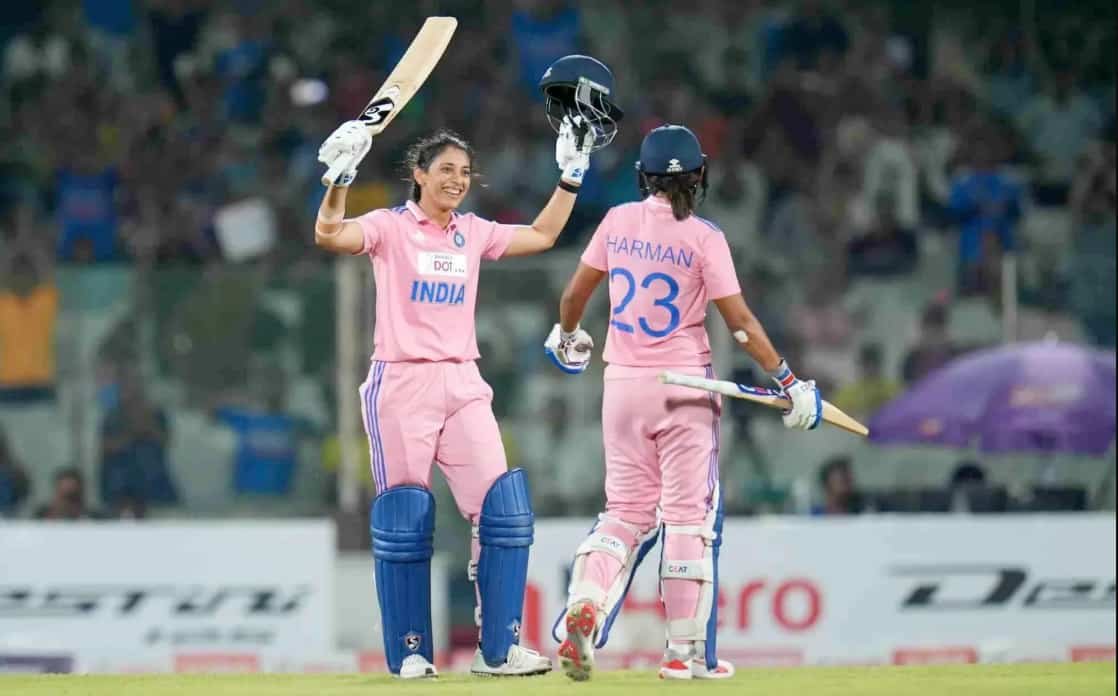
- In 2025, Smriti Mandhana joined her in the elite club with a fifty-ball hundred against Australia in Delhi. Facing one of the world’s best bowling attacks on home soil, Mandhana showed why she’s considered one of the most elegant stroke-makers in the game. Her timing is so clean that she doesn’t need brute force. Against Australia, she combined placement with power, and the result was India’s fastest ODI century by a woman.
Top Performers in Women’s T20 International Cricket
T20 cricket demands aggression from ball one. There’s no time to settle in, no time to build slowly. The fastest hundreds in this format reflect that urgency.
- After Dottin’s 38-ball record, Alyssa Healy comes closest with a 46-ball century against Sri Lanka in Sydney in 2019. As a wicketkeeper-batter who opens the innings, Healy sets the tone for Australia’s batting. That day in Sydney, she didn’t wait for anything. From her first delivery, she attacked. Sri Lanka’s bowlers couldn’t find a line or length that worked. Healy hit the ball to all parts of the ground, and by the time she reached 100, Australia was already in control.
- Tammy Beaumont needed 47 balls for her T20I century against South Africa at Taunton in 2018. The ground helped—Taunton has shorter boundaries—but Beaumont still had to execute. She opened the batting, took on the new ball, and hit cleanly. England posted a massive total and won comfortably, largely because Beaumont gave them a foundation that South Africa couldn’t chase down.
- Harmanpreet Kaur scored the fastest T20I century by an Indian woman—49 balls against New Zealand in Providence, Guyana, in 2018. Kaur is known for her ability to clear boundaries with ease, and against New Zealand, she used every bit of that power. The conditions suited batting, but Kaur still had to deliver under pressure, and she did.
When Australian Dominance Shows Up Twice
Meg Lanning appears on this list twice. Her second entry came in 2019 when she scored a 51-ball T20I century against England in Chelmsford.
By then, she was captain, and the innings showed her evolution as a player.
She combined power with smart cricket—rotating strike, picking gaps, and accelerating when needed. Australia won easily, and Lanning reminded everyone why she’s one of the best to ever play the game.
England’s Impact Player in India
Danielle Wyatt scored a 52-ball T20I century against India in Mumbai in 2018. Playing at the Brabourne Stadium in front of a massive home crowd is intimidating, but Wyatt thrived.
She opened the batting and attacked from the first ball. India rotated bowlers, changed fields, tried everything. Wyatt kept scoring. England posted a huge total, won the match, and Wyatt’s innings became a statement: England could compete anywhere.
Expert Insight: Why Speed Matters in Modern Cricket
Fast centuries aren’t just about personal records. They change matches.
When a batter scores quickly, it puts pressure on the opposition’s entire game plan.
Bowlers start doubting their lines. Captains make defensive changes earlier than they’d like. The momentum shifts.
In T20 cricket, a quick fifty or a hundred can make the difference between a defendable total and an unbeatable one.
In ODIs, it forces the opposition to play catch-up for the rest of the innings.
These rapid centuries aren’t flashy for the sake of it—they’re tactically devastating.
Fastest Half-Century Benchmarks
- While centuries get the headlines, fifties matter too.
- The fastest half-century in women’s T20I cricket was scored in just 18 balls by Deandra Dottin (yes, her again) in 2010 against South Africa—the same match where she set the century record.
- In ODI cricket, quick fifties set the platform for those explosive hundreds.
- Players like Healy, Mandhana, and Lanning regularly reach fifty in under 30 balls in ODIs, giving their teams the kind of starts that put matches out of reach early.
How It Compares: Fastest ODI Century in Men’s Cricket
- For context, the fastest ODI century in men’s cricket belongs to AB de Villiers, who scored it in 31 balls against the West Indies in 2015.
- The men’s T20I record is held by Sahil Chauhan of Estonia, who reached 100 in just 27 balls.
- But comparing men’s and women’s records directly misses the point.
- The bowlers are different, the pitches are different, and the context is different. What matters is dominance within the format, and these women dominated.
FAQs
- Which player has scored the fastest century in women’s cricket?
Deandra Dottin holds the record with a 38-ball century in a T20I match against South Africa in 2010.
- Who scored the fastest ODI century in women’s cricket?
Meg Lanning scored a century in 45 balls against New Zealand in Sydney in 2012, which remains the fastest in women’s ODI cricket.
- Has any Indian woman scored a century in under 50 balls?
Yes. Harmanpreet Kaur scored a T20I century in 49 balls against New Zealand in 2018, and Smriti Mandhana scored an ODI century in 50 balls against Australia in 2025.
- What’s the difference between T20I and ODI fast centuries?
T20I matches are shorter (120 balls per team), so fast centuries are more common and often faster. ODI matches are longer (300 balls per team), making a quick century harder because bowlers have more time to set defensive fields.
- Why do faster centuries happen more often now?
Modern cricket emphasizes aggressive batting, better training, and power-hitting skills. Players are coached to attack from the start, and the game’s evolution has made quick scoring not just possible but expected.
Final Thoughts:
The fastest centuries in women’s cricket aren’t accidents. They’re the result of skill, preparation, and courage.
Dottin’s 38-ball record might never be broken. Lanning’s 45-ball ODI century set a standard that took 13 years to approach.
Healy, Beaumont, Kaur, Mandhana, and Wyatt have all shown that when the moment demands it, women’s cricket has players who can deliver something extraordinary.
These innings remind us that cricket isn’t always about patience. Sometimes, it’s about attack. And when it works, it’s unforgettable.
Also Check:
- WPL Purple Cap Winners List
- Richest Indian Women Cricketers
- Most Beautiful Women Cricketers In The World
- Women’s Premier League WPL Winners List
About the Author